
Eleven days changes everything
On October 15, I surveyed four different approaches to the same problem: purge waste. None of the answers was quite buyable yet.
That changed fast. Creality opened U.S. pre-orders for its K3 on October 12 at $849; it swaps whole nozzle assemblies instead of flushing filament. Snapmaker’s U1, the other $849 tool-swapper, is already shipping — and has been discounted to $749 in a flash sale. And on October 23, Bambu Lab teased a nine-tool machine, the H3C, for a November 3 unveiling. So the question is no longer “which idea wins?” It’s “buy now, pre-order, or wait two weeks?”
What they have in common — and why the price tie matters
Strip away the branding and the two $849 machines are eerily matched: roughly 5-second swaps, 500 mm/s top speed, 20,000 mm/s² acceleration, a 300°C hot end, and a 100°C bed. The K3 builds 260 × 260 × 260 mm; the U1 builds a slightly larger 270 mm cube. Neither base machine has a heated chamber — both need an optional top cover before ABS and ASA become sensible.
That tie is the story. A year ago, a toolchanger meant Prusa XL money — thousands, not hundreds. Now the differences are about how they swap and how proven they are, not the headline specs.
The real difference: swapping a nozzle vs. swapping a toolhead
The K3’s KliTek system swaps a nozzle assembly — nozzle, hot end, and tube together, roughly 54 grams — in a claimed 4.8 seconds, with a full color change in under 15 seconds. Creality says the assemblies use USB-C connectors and cost about $14 each. When a nozzle wears out, you replace a small, cheap part, not a mechanism.
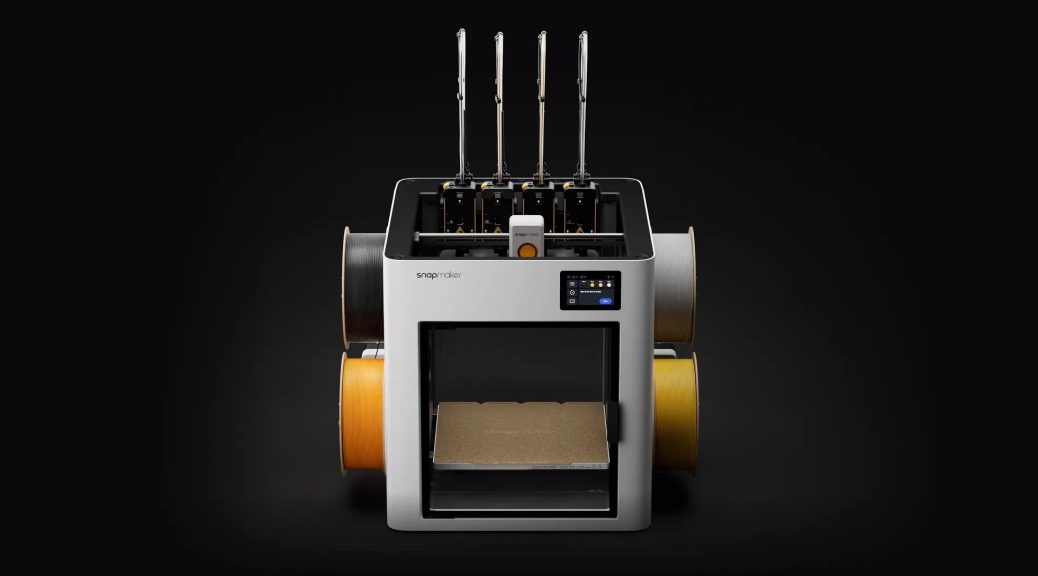
The U1 swaps the entire toolhead — four complete toolheads parked on a rack, each with its own filament. Each color has its own everything, so there is nothing shared to contaminate. In independent comparisons, the U1’s swaps land in the 5–12 second range on real prints, and its waste on a three-color model with 90 changes was measured at around 4 grams, against 62 grams for a filament-switching machine. Creality K3 vs. Snapmaker U1 comparison
What only the K3 does — and what it costs extra
The K3’s party trick is mixed nozzle sizes in a single print: 0.2, 0.4, 0.6, and 0.8 mm nozzles in one job, so fine detail gets the small nozzle and infill gets the big one. It also claims TPU from 85A to 95A and a CMYK blending mode using translucent filaments. Creality’s K3 pre-order announcement
Read the fine print, though: mixed nozzles need an add-on kit, softer TPU needs a TPU kit, and the top cover is optional. None of those kits had a U.S. price at launch. Out of the box, the K3 ships with four 0.4 mm nozzles and prints TPU 95A. If your reason for buying is “four colors of PLA,” the K3’s extras buy you nothing the U1 doesn’t already do.
Proven vs. promised
This is the deciding factor for me. Snapmaker says it has shipped more than 100,000 U1s, and reviewers have put hundreds of hours on machines bought at retail — not loaners. The K3 has shipped to no one yet: shipping is estimated from November 2, and Europe follows in December. Pre-orders placed by November 30 on Creality’s store include four free rolls of Hyper PLA and free shipping, but every K3 performance number so far — the 800,000-cycle durability claim, the sub-25-micron repeatability, the 85% waste cut — is Creality’s own lab testing. Creality K3 pre-order coverage
That doesn’t make the K3 a bad bet. It makes it an unreviewed bet, and at the same $849 as a reviewed machine, “unreviewed” needs a reason — mixed nozzles, soft TPU, or Creality’s ecosystem and native root access.
The wildcard: wait until November 3
Then there’s Bambu Lab. Its October 23 teaser names the H3C, shows a nine-tool rack, and uses the taglines “Tool Changer, Game Changer” and “A New Tech to Swap.” VoxelMatters, which premiered the teaser, puts the unveiling at November 3 at 9 AM EST (the November 4 date in some screenshots is the same moment in Australian time). No price or spec has been announced. VoxelMatters: Bambu Lab H3C teaser · ToolGuyd: Bambu H3C launch teaser
Nine tools would beat every desktop toolchanger on the market — the U1 and Flashforge Creator 5 stop at four, the Prusa XL at five. It will also almost certainly cost far more than $849: Bambu’s existing H2C combo is already around $2,200. So the H3C is not a reason to skip the $849 tier. It is a reason to pause if you are already shopping in Bambu’s ecosystem, or if you want more than four tools.
My take
- Buy the U1 now if you want four-color printing that works today, especially while it is on sale. It is the known machine at the known price.
- Pre-order the K3 only if mixed nozzle sizes or soft TPU are the reason you are shopping — and budget for the unpriced kits.
- Wait until November 3 if you are a Bambu Lab shop, or if nine tools would change what you print. A two-week wait costs nothing; a $2,000-plus surprise the week after you buy stings.
I’ll revisit this once K3s reach reviewers and the H3C’s spec sheet is real. Until then, the purge era’s replacement has a price — $849 — and you can actually buy one half of it today.
Gear mentioned: Snapmaker U1 on Amazon · Creality K3
As an Amazon Associate I earn from qualifying purchases, which helps cover the cost of keeping this site online.
Photo Credit: Snapmaker